PAPARAZZI UAV BLOG

Research and development of open-source UAV systems since 2003

Research

4 March 2020 · Gautier Hattenberger

Flight Campaign at Barbados Island

Enac UAV lab have participated to an atmospheric research flight campaign at the Barbados Island for three weeks from end of January 2020. 

This was part of a project called NEPHELAE in collaboration with the French National Meteorological Research Center from Météo-France and the robotics lab LAAS-CNRS.

NEPHELAE is atmospheric science driven (with a focus on cloud microphysical processes) via robotic technological development (adaptive, model-guided path planning in a UAV fleet). Essentially, by merging the state-of-the-art technology, the observational tools for conducting research in atmospheric science will take a quantum leap forward. At the same time, we are using this novel approach to address decades-old questions on entrainment and the onset of precipitation that have been limited by traditional observing methods.
Read article →

21 June 2018 · Gautier Hattenberger

UAV Network Intrusion Detection with Wavelet-based Signature Analysis

This is a first step of a hybrid IDS method based on the analysis of spectral traffic and a robust controller / observer for the estimation of anomalies in UAV networks. This module is currently designed to observe the traffic between the drones and the Paparazzi GCS. It provides a statistic signature of the traffic which can later be used to determine the nature of the traffic. The module is tested in face of a DoS attack and the results are very promising!

Read article →

15 June 2018 · Gautier Hattenberger

Opening ENAC's flying arena

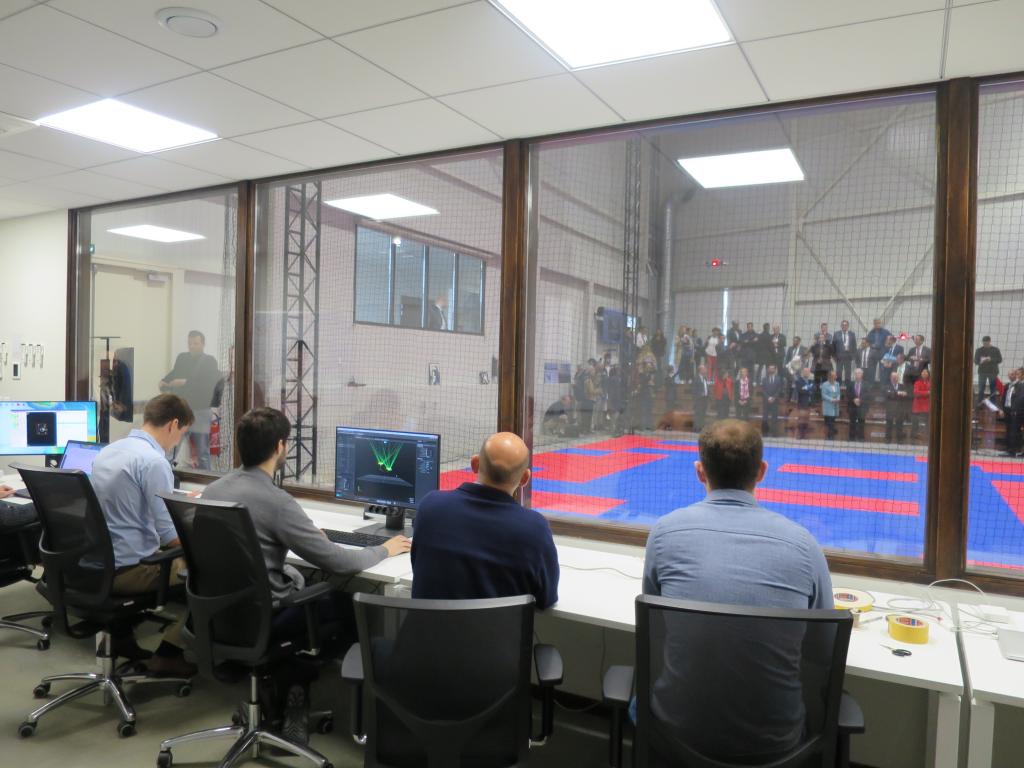
Since the beginning of the year, ENAC (French Civil Aviation University) is equipped with a new facility dedicated to UAVs research and education.

The building includes a flying arena with a size around 10x10x10 meters, several workshops for mechanics, electronic, composite, 3D printing and storage. It also includes a teaching room for automatic control and the student’s robotics club.

The official opening was the 17th of May in the presence of the French minister of transport. Several demonstrations have been performed, all of them showing the formidable capabilities of Paparazzi: distributed formation flight, hybrid vehicles, on-board image processing, efficient adaptive control and autonomous navigation.

Read article →

2 December 2017 · Hector Garcia de Marina

Pilot a super rotorcraft!

So far all my results with rotorcraft were in simulation… until now! In this experiment, performed at TU-Delft (thanks Ewoud Smeur!), a team of four rotorcraft behaves as a single unit. The proved stability properties of the whole system allows for applications such as collaborative transportation of objects.

If you want to know the mathematical aspects and why this setup works, then check my thesis.

A wiki entry explaining how you can have the same setup running employing Paparazzi will be available soon!

Read article →

12 August 2017 · Hector Garcia de Marina

Multi-UAV capabilities

Video done at ENAC (Toulouse) showing some capabilities of Paparazzi for controlling multiple fixed-wing aircraft.

We have already a wiki entry explaining how to implement the circular formations.

Read article →

12 March 2017 · Hector Garcia de Marina

First flights of the hybrid vehicle Cyfoam with Chimera board

The Cyfoam is a hybrid vehicle developed at ENAC Drone Lab. The aircraft is a foam, with a 3D printed fuselage, version of the composite-made Cyclone.

The vehicle is powered by the new autopilot board Chimera! which executes the control algorithms developed by Ewoud from Delft MAV Lab. We are currently aiming at a total autonomous mode, e.g., auto take off and auto landing.

Read article →

24 February 2017 · Gautier Hattenberger

Flying Parrot's Disco aircraft with Paparazzi

The Disco from Parrot is a fixed-wing aircraft designed for FPV with all the feature already available on their Bebop2, plus some extra things, like airspeed sensor, SBUS input and PWM outputs.

The autopilot itself is all integrated in a box called C.H.U.C.K. and it allows nice and easy flights with the SkyController2 and the Cockpitglasses, connected via Wifi.

Just like the Bebop and ARDrones, it is now possible to fly this drone using Paparazzi. Just connect to the plane, upload your code and you’re ready to go! Here is the video of the maiden flight:

Read article →

21 February 2017 · Hector Garcia de Marina

Circle formations of fixed-wing aircraft

We have recently developed and tested a formation control algorithm for fixed-wing aircraft in Paparazzi at ENAC. The position of an arbitrary number of vehicles can be controlled in a circular path. In fact, we are not restricting ourselves to circles but to any closed orbit, such as ellipses, thanks to the guidance vector field that guides the planes. The algorithm is under more tests, but it should be soon available for the general public. It is quite easy to employ, the user has to declare only the IDs of the planes, the communication topology (neighbors’ relationships) and the desired inter-angles. A detailed explanation will be posted soon in the wiki. In the following video the planes exchange positions every second. Delays, out-of-date positions (GPS delays), packet losses, etc are expected to be (and actually they are) present. It is quite interesting to remark how robust the algorithm is. According to our calculations the impact of such nasty things are not very important (ofc up to a certain point) for the convergence of the algorithm.

Read article →

24 October 2016 · Gautier Hattenberger

IMAV2016

The International Micro-Air Vehicle Conference and Competition was held last week in Beijing, China, organized by the Beijing Institute of Technology and the National University of Singapore.

As usual, the level of the teams involved in the competition is higher year after year and we had a great show. The team from the MAVLAB of TUDelft was participating to both indoor and outdoor session. During the outdoor, they unfortunately couldn’t show their best due to many communication issues, preventing them to fully use their RTK Bebop2 (and also some regressions in Paparazzi code, hum hum… :( ).

Read article →